Wednesday, November 3, 2010

Game Object Construction Rabbit Hole

Today I want to write a little bit about a boring, yet utterly fundamental part of game engine design: spawning game objects.

Garry's Mod makes it look easy.
Say you have a level that contains a player object and an enemy object.  However these objects are represented in memory, you have to allocate them somehow.  And probably register them with some sort of update loop, and maybe load some other data (graphics, sound?) associated with those objects.  There's a little bit of bootstrap to just get the game into a state where the simulation can start.

So, how do you do it?  How do you get that player and enemy up and running?  This is one of those problems that can be as complex as you choose to make it.

Well, I mean, you could write a function that looks like this:

void startUpGame()
{
   spawnPlayer();
   spawnEnemy();
   // done!
}

Sounds good until you get to level 2, which has two enemies.  You could make a spawning function for every single level, I guess.  It would work, but it wouldn't scale, especially if you have lots of objects to spawn.  I think the average Replica Island level has several hundred objects to spawn, so writing one of these for each level would suck hard.

Long, long ago I wrote a game called Fysko's Playhouse for Mac OS 6 computers.  If that fact alone doesn't date me, this will: it starred the mascot of a local BBS of the same name.  Anyway, back then I had no idea what I was doing, and so when faced with this problem of how to spawn game objects for different levels in a way that doesn't suck, I hit the code with a hammer and moved on.  My solution back then was to write a level editor (in HyperCard!!) that would output start up functions like the one above.  I could draw a level in the editor, hit a button, and out would pop a bunch of Pascal code which I could then copy and paste into the game.  Great!

Well, not really.  That kind of solution works only for very simple games and only when the programmer is the level designer.  And even then it's kind of crappy.  Move a guy 2 pixels to the left and you have to recompile your code.

Some years later I wrote a Bomberman clone called Bakudanjin.  This time I was a little smarter.  Instead of hard coding my level information, I made a map file describing every level.  The map file was basically just a bunch of indexes with XY locations.  To start the level, I load the file and then walk through each index.  The index maps to a table of function pointers (or, since this was also Pascal, a big-ass switch statement) that call the appropriate spawn functions.  Actually, Replica Island works this way too.

And if you just clicked on that link, you can see why this method isn't so hot either: Replica Island only has about 50 different object types and that code is still 6500 lines long.  And a lot of it is copy and paste, because many objects turn out to be structurally similar.  And god forbid you accidentally get your map format indexes out of sync with your runtime indexes; arbitrary enums needing to correctly index into separate arrays is a recipe for bugs.

Still, this is a quick and easy method, and it worked fine for Bakudanjin and Replica Island.  All that code gets thrown out and rewritten when I start a new game, though.

The problem here is that all this bootstrap code is basically code describing data.  I draw a line between "code" and "data" as follows: code is literally programming that instructs the game how to operate.  Data is non-code that is input to the code system.  You feed data into your game and out comes a playable simulation.  Things like enemy placement on a map are subject to lots of iteration and change; the code to actually move an enemy to that location is probably pretty stable and static.  Therefore, the placement information is data and shouldn't live in code, while the runtime for consuming that data is code but can be generic and reused across multiple levels and games.

So in order to write better code and to enable faster iteration and reusability, it's probably a good idea to move more of the information for spawning guys into data.  Moving spawn locations into a file wasn't a bad first step, but we can go further.

What does spawnPlayer() do, anyway?  It probably allocates a bunch of objects, ties them together with pointers, and sets a bunch of parameters on those objects.  Hmm, sounds like something we could represent with just some smarter data.

How about this: we'll make all objects in the world basically the same, make a single spawnObject() function, and then expose a bunch of parameters which we can use to customize the objects and differentiate them.  If we can do that, all we need to do is serialize all the parameters and pass them to spawnObject().  Health = 5, Speed = 10, Sprite = "AngryGorilla.png", etc.

GameObject* spawnObject(ObjectParams* params)
{
   GameObject* object = new GameObject;
   object->setLife(params->life);
   object->setSprite(params->sprite);
   if (params->isThePlayer)
   {
      object->setRespondToControllerInput(true);
   }
   // ...
   return object;
}

OK, that works, but now we have a new problem: it's actually pretty hard to make all our objects exactly the same.  Take the code that reacts to controller input, for example.  That belongs on a player object but on nothing else; with this type of system every single angry gorilla is going to carry that code around, probably turned off with a flag that we serialized.  Or consider what happens when an object is hit.  The player probably wants to get damaged, go into a short invincibility mode, and then go back to normal.  The enemies probably want to get damaged and not be invincible.  If the player dies there's probably some code to cause the Game Over screen to pop up.  Not so for an enemy.

We could make this all the same code and control it with flags, but it's going to become ugly fast.  Maybe if we can refactor our game such that all objects are functionally similar we can ease the pain, but that will make it hard to say, add in little bits of player-specific hacks to improve the feel of game play later.  A better system would be able to generate objects that only contain the code that they need.  If we use the aggregate object model that I often recommend, we could think of this as only inserting relevant components.  In a more traditional object model, we could think about instantiating the object at a particular level of derivation from the base to provide only the necessary set of functionality.  Either way, we're talking about sticking code together with pointers and setting parameters.  Hmm, sounds like data again.

One method I've seen but never tried myself is to define a hard-coded list of object types ("player", "angry gorilla", "banana bomb", etc), and then provide a unique struct of static spawn data related to each type.  For example, the player object would be allocated to contain code for movement based on the controller, and it would read at spawn time a PlayerObjectData struct.

GameObject* spawnObject(ObjectType type, void* params)
{
  GameObject* object = NULL;
  switch (type)
  {
    case TYPE_PLAYER:
        object = new PlayerObject();
        object->parseParams(static_cast<PlayerObjectData*>(params));
        break;
    // ...
  }
  return object;
}

The attractive thing about this method is that you get a chance to control object creation on a per-type basis, but you can also serialize different data for each type, thus avoiding the one-size-fits-all problem.  That should let you move almost all information about this object into data, and just leave this one spawn function in code.

But let's go a step further.  Say we don't want to have to enumerate every object type in code.  If objects are really just collections of data and code, why can't we move the entire structure of a game object into data?

In a language that supports reflection, this shouldn't be too hard.  We can encode an entire object hierarchy, say as XML, and then use it to allocate classes, patch pointers, and set fields.  In a language like Java, we can look up class names by string and instantiate them, and poke into fields to finish constructing objects.  We can imagine some XML that looks like this:

<object name="gorilla" type="com.gorillaboom.gameobject">
  <field name = "mLife">10</field>
  <field name = "mSprite">gorillagraphic</field>
</object>

<object name="gorillagraphic" type="com.gorillaboom.imagefile">AngryGorilla.png</object>

If we write an XML parser to build object trees for us based on this, our entire spawn code can become a single call to that parser.  The parsing code is complicated but generic, it can be reused across objects and levels and games.  And we still have the ability to customize each object because the hierarchy can contain custom classes or be structured differently per type.

GameObject player = (GameObject)constructFromXML("player.xml");

Even cooler, this method isn't even specific to game objects.  We could use it to serialize all sorts of data, even the contents of our main loop.  The code is still code, but once we put the structure in data we have a crazy amount of control.

But, getting back to just the game object application of this idea, there are two problems.  First, this approach requires us to walk the XML object tree every time we want to spawn an object.  We could try to walk the XML once and then use the resulting object tree as an entity "archetype," but that way leads to a particular brand of hell known as "shallow copy vs deep copy." When trying to copy the tree to create a new game object instance, how do you know which pointers should be recursively copied and which should be copied by value?  People have lost years of their life to that problem.

A less practical but ultimately simpler solution is just to re-parse the XML for every instantiation.  Which brings us to the second problem: reading XML and stuff is slow.  I mean, really slow.  Compared to the simple code functions we started with, it's glacial.  And allocation-heavy.  Not something we really want to do during the runtime of a game.

I know what you're going to say.  Hey, dumbass, just use a binary format instead of XML.  Problem solved.  And that's true, to an extent.  Excuse me for a moment while I go out on a limb to the extreme of this line of thought.

If you're going to go to a binary format, why not just store the entire object tree in its native memory format on disk?  Build the object hierarchy offline, write it as binary data to a file, then load it at runtime and just patch pointers.  Boom, instant object tree.  In C++ you can actually do this by building your own reflection system, making liberal use of placement new, and then walking the objects stored in the file to patch pointers.

I've actually written this system before.  It becomes horrifically complicated, but it does work.  A couple of years ago I wrote an engine that could load a binary blob of C++ objects as a contiguous block, walk the objects therein to patch vtables and other pointers, and then simply start using the objects as regular fully constructed C++ objects.  You lose constructers (objects were constructed before they were written to disk) and destructors (lifetime of the object is the lifetime of the blob; individual objects within the blob can't be freed), and god help you if you try to manage those objects with reference counts or smart pointers, but the method does work and it's pretty fast.  To make a new instance of the object tree, you can just memcpy the whole block and repatch pointers.  Cool.

It starts to break down when you need to target multiple platforms, or build your data files on an architecture that does not match the runtime architecture.  These problems are also solvable, but probably not in-place; you'll need to read the objects out of the file and then allocate them at runtime to ensure padding and vtable placement is correct.  And if you do that you're back to a lot of runtime allocation and object parsing.  The system is still complicated but some value is lost.

So for a new code base that I'm working on, I'm experimenting with a slightly different approach.  I still want to use the "load code structure from data" approach, but I don't want it to be slow or architecture dependent (or complicated, if I can avoid it).  And I need to be able to spawn objects with this system dynamically at runtime.  So instead of constructing objects directly, I'm constructing factory objects that can generate new instances of my object hierarchy on the fly.

The method is to read in an object hierarchy as XML.  Instead of building the tree right there, I build a bunch of "instruction" objects--basically the minimal list of commands required to recreate the object tree described in XML.  "Create an object of type GameObject," "Set field mLife of object index 5 to 10," "Point field mSprite of object index 22 to object index 25."  Each of these small "patch" objects gets initialized with a single command (representing a delta from the default state of the object upon construction), and the whole list of patches is stored in a factory object I call a "builder."  Reading the XML is still slow, but I only need to do it once before the game starts; at runtime, when I want to spawn a new object tree, I simply execute the appropriate builder.  The runtime speed is similar to what we had way back at the top of this lengthy post: just a bunch of object allocations and field initializations.  Should be pretty fast.

Builder* enemyBuilder = makeBuilderFromXML("angrygorilla.xml");

GameObject* enemy1 = enemyBuilder->build();
GameObject* enemy2 = enemyBuilder->build();
GameObject* enemy3 = enemyBuilder->build();

One nifty aspect of this approach is that I can easily extend the XML format to do more complicated things by building more complex patch object types.  The basic set of patches (int, float, vector, pointer, string, etc) are entirely generic, as is the builder system itself.  But I can add to that engine- or game-specific patches if necessary.  I've already added a patch that knows about this particular engine's asset system, and can use it to schedule other files for loading, thus allowing for references to external assets which may be loaded in the future (and patched at that time appropriately).  A different game might have an entirely different asset system, in which case I can chuck the one patch written for this game and write a new one against that engine; the system should scale without losing its general purpose core.

The actual XML parser and builder system is very simple--only a couple hundred lines of code.  But I should mention that it only works in C++ because my game engine is backed by a (fairly involved) reflection system.  Using an Interface Definition Language, I can create classes that are laden with meta data, much like Java's Class object.  Using that data I can poke into anonymous classes at runtime and set fields, which is how the patches in the builder actually work.  I think this approach could be done without reflection, but it would basically resemble the hard-coded types with unique static data structs method that I mentioned above.  I'll talk more about the reflection system in a future post.

To bring this giant document to a close, I just want to note that the methods I've described here are hardly an exhaustive list.  These are the various approaches that I've tried to spawn objects in games; there are many others and probably a lot of really good ideas that I've never considered.  But when making a game engine, the question of how objects get spawned--and what a game object actually is, is a pretty huge piece.  Though sort of mundane, it's probably worthy of a lot of thought.

Friday, September 17, 2010

Long Time, No See

I haven't written anything here lately because, well, I've been swamped, and I mean like seriously submerged in the murky depths of work, travel, and more work.  We're talking Creature from the Black Lagoon levels of swamped here.  I'm probably growing gills.  That would actually be pretty cool.


Apparently I need to, at the very least, log in to the blog a little more often because I was pretty surprised to find 45 comments awaiting moderation today.  Sorry about that.  I turned off moderation for now, and unless the spammers ruin it, we can leave it off.

That said, let's lay down some ground rules.

1) If you're stuck, or have a question about a particular level, posting a comment here is probably not the fastest route to an answer.  I don't have time to answer (I'm swamped, remember?), so another forum someplace might be a better bet.

2) I love bug reports.  I especially love bug reports that are entered into bug reporting systems.  If you'd like to report a bug (or, as the case seems to be most commonly, a feature request), there's a whole official-looking system all set up for you already.

3) There's some pretty interesting code discussion going on at the forum setup for that purpose.  If you want to talk code, that's the right spot.

So, being swamped, I don't have a whole lot of new information to report, so I'll leave you with two cool things.

First: there are at least five games on the Market that were built with Replica Island code: Android Jump (Papijump clone), Prototype (an Arkanoid game with some interesting twists), Greedy Pirates (a Nanaca Crash sort of game with cannon balls instead of safe-for-workified girls), Super Treasure Rocket (a platformer), and Project G.E.R.T. (I'm not sure what to call this one).  Though not yet on the Market, there's also a pretty neat Fruit Ninja clone, complete with 3D fruit to slice, that was built on the RI code.  I think that's pretty freaking awesome. Update: We can add Ski Classic and Auto Traffic to the list, as well as Pocket Racing to list!  These games were built with SpriteMethodTest source, which is basically the primordial version of the renderer in Replica Island.

Second: Here's a picture of the Replica Island booth (part of a larger Android booth) at Tokyo Game Show this week.  This was all put together by a third-party event organizer, and while I gave them permission to show the game, I had no idea it'd be so, I dunno, official looking.  Cool!

Sunday, June 20, 2010

Replica Island Passes a Million Installs

Holy crap!

Replica Island passed 1,000,000 installs today, 103 days since its launch on March 9, 2010.

Thanks for your support, everybody!

Monday, May 3, 2010

Control Configuration and Abstraction


The #1 thing that I've learned since shipping Replica Island is that users want configurable controls.  I mean, I might have guessed that some devices would have one sort of controller and not another, but I didn't anticipate the number of people who prefer a specific control configuration even when others are available.  Users with trackballs and directional pads asked for configurable keyboard settings, and when I added orientation sensor-based movement for devices without other controls (I'm looking at you, Xperia), many users who could already play the game chose to switch to tilt controls too.  I've made four updates so far and all of them have had to do with the input system; in the first three I added more and more configuration options, and in the most recent (v1.3) I rewrote the core input framework to improve non-standard control configurations.

When I started writing Replica Island, the only device available was the G1.  About half way through development I switched to an HTC Magic, and at the very end of development I switched to a Nexus One. The game was entirely designed around HTC's trackball-on-the-right design.  Fairly late in development, devices sporting directional pads (like the Motorola Cliq, and more importantly, the Droid) started to hit the market, so I added some support for d-pad controls.  I didn't really think anybody was going to use the keyboard to play, so I only added a few key-based controls to support the ODROID.

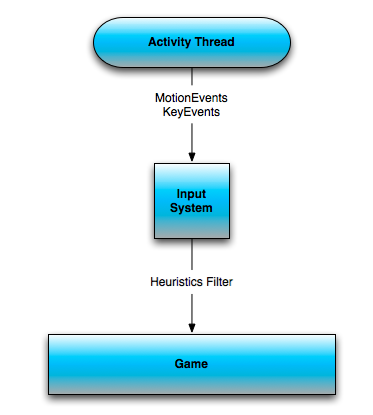
The input system started out like this:


MotionEvents from touch and trackball motion, as well as KeyEvents, were passed to the InputSystem (via the GameThread, for reasons I'd rather not discuss), which recorded them in some internal structures.  The goal here was to abstract the Android events from the game interface.  The game wants to be able to say things like "is the jump button pressed," or "was the jump button just pressed since the last frame," or "how long has it been since the last time the button was pressed."  It's a query-based interface, rather than the message-based interface that the Android framework provides.  So the initial role of the InputSystem was to record Android events so that they could be queried in the future.

The trackball was tricky to get right.  I want to allow the player to flick the trackball in a direction and have the character get an impulse in that direction scaled by the magnitude of the flick.  But the Android motion events come in at a fixed frequency and fixed magnitude, so in order to build a vector describing recent motion, I needed to maintain some history between motion events.  My first implementation, which survived for the entire course of development, was to cache a history of 10 motion events and calculate the average direction of motion across all of them to find the flick direction and magnitude.  After a specific timeout had passed with no new events, the cache was cleared and averaging would begin again with the next event.

This worked ok as a way to calculate a motion vector, but it had problems.  The biggest issue was that there was no way for a user to move slowly; even if the user rolled the ball slowly (thus causing motion events to come less frequently), as long as he rolled fast enough to make the internal event timeout, the events would get averaged together and would come out looking the same as a fast flick.  So users who tried to move with precision or in small steps often found themselves rocketing across the level.

When I went to add d-pad support, I just treated the pad as a different source of motion events.  I treated each keydown as a roll of a specific magnitude in a specific direction, and fed that into the same cache system I used for motion events.  This worked, sort of: it allowed me to pipe the directional pad through the trackball interface (which connected directly to the game) pretty easily, but it didn't feel good.  The problem with this approach was that directional pad events don't need any averaging; in fact, you want exactly the most recent state to be represented, as the player can release a key at any time (the trackball, unlike other kinds of input, never goes "up", and thus required a history).  So directional pad support in Replica Island, in the first few versions, sucked.

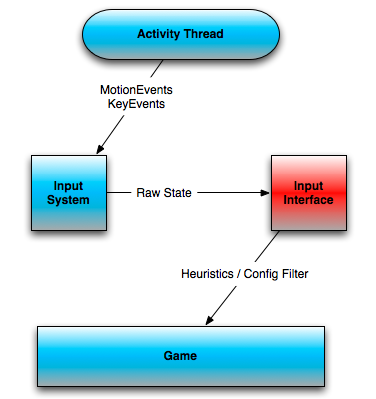
Add in configurable control options and very quickly my simple G1-centric input system grew into a mess that didn't work very well.  So, for the most recent version, I rewrote the whole thing.  Now the structure looks like this:


The main change here is to separate input recording (necessary for querying) from game-specific filtering and control configuration switching.  The InputSystem is now generic; it just records input events from the keyboard, touch panel, orientation sensor, and trackball, and provides an interface for the current state (as defined by the most recently received events) to be queried.  A new system, InputGameInterface, reads the hardware state from InputSystem, applies heuristics and filters, and presents fake buttons for the game to use.  This way the game can ask for the "directional pad" and get input from a trackball, orientation sensor, keyboard, directional pad, or whatever, already filtered and normalized.  I put all of the filtering code for the trackball into this class, and I can now pass directional pad input directly to the game without tying it to the trackball.

Speaking of the trackball, I changed my approach to filtering.  Now I accumulate trackball events that occur within a very short cutoff, and average them after a slightly longer cutoff.  Instead of turning the trackball input "off" after a fixed duration, I make it decay until it reaches zero.  This lets the user make small, precise movements, and still get a big motion from a large flick (as in the latter case, events occur in rapid succession and accumulate).  This method also gave me an obvious spot to stick a sensitivity factor for the trackball, which several users of devices with optical trackpads (HTC Desire, Samsung Moment, etc) had requested.

The new system probably needs a bit more tuning, but I played the game through with it and it feels pretty good.  The code is about 100x cleaner now, and InputSystem is something that others can easily reuse without any other dependencies.

Sunday, April 11, 2010

Design Post-Mortem: Three Mistakes

While I'm pretty happy with Replica Island, releasing it has definitely been a learning experience.  Some of the design choices Genki and I made were good, others were ok, and a few were bad.  Today I'm going to talk about three mistakes I made in the design of this game.

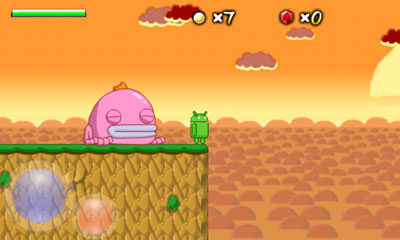
Mistake #1: This particular jump.


Turns out that a lot of players die right here.  Heck, I have the metrics to prove it.  This is sort of a difficult jump because you have to make it across a wide pit and then land in a very small space near the top of the screen.  This jump started out a little easier, but it got harder when I compressed the vertical size of this level to deal with some camera problems.  The real problem here, though, is the distance.  It turns out that this is the first spot in the game where you are required to use second-order flying skills to reach the other side.

Just what is that skill?  Well, it turns out that some players never realize that they can stay aloft for longer if they let momentum rather than fuel carry them forward.  If you press the jump button and get your speed up in the air, you can release the jump button and stay aloft until gravity overtakes you and you begin to fall.  At that point you can hit the jump button again to combat gravity and maintain your altitude.  You can't do this forever because you'll eventually run out of fuel, but using this method you can jump much greater distances than if you just hold the jump button down constantly.
The real problem is that I never teach players how to fly that way explicitly.  There is lots of tutorial levels designed to make sure you can fly, but it turns out that only the most basic flying skills are required to get passed those sections.  This area is the first in which you cannot progress unless you've figured out how to use the more complex flight mechanics, and people get stuck here.

What can I do about it?  Probably this area itself is fine; a better tutorial on this particular skill is probably in order.

Mistake #2: The Case of the Robot Spewing Spawner


When I made the robot spawners, I though it would be a funny easter egg if you could possess them.  Part of the plan was to allow the possession orb to possess any machine, and I thought possessing the spawners would be a little hidden reward for users that experiment.  The problem is, I added this functionality before we understood how the robot puzzles were going to work; in the final game, it's trivially easy to possess a spawner, and most users are confused rather than elated.  Even worse, being able to possess a spawner sometimes gets in the way of possessing a robot, which is pretty annoying.  I realized that this might be a problem before we released the game, but I left it alone because I thought it was funny.  Now there are multiple videos about it.  Pretty undeniable proof that I messed this up.

What should I do about it?  I should probably turn the easter egg off or at least find a way to make it much harder to find.

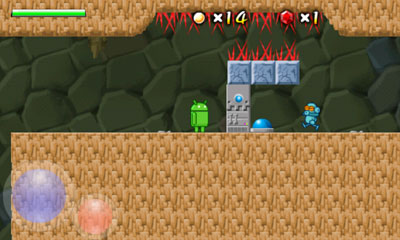
Mistake #3: The impossible puzzle.


You have no idea how many people have e-mailed me about this puzzle.  It's clearly the most difficult part of the game for a huge number of users.

In the first version of the game, this section was missing the red spikes due to a bug in the level data, which made this puzzle even more confusing.  But even after fixing that, I continue to get several e-mails a day asking about this part.

If you don't want this puzzle spoiled for you, stop reading now.

OK, I warned you.  The solution here is to use the Possession Orb to grab the robot and run him into the button.  Pretty simple, I thought; the real challenge in this puzzle's original form was actually just maneuvering the Orb through the spikes before it dissipates (in an update I added a gem to this level, so the Orb survives for longer).  But it turns out that users weren't even figuring out that they could use the Possession Orb here, even though they've seen this pattern several times in slightly different contexts earlier in the game.

I finally realized what the real failure is here: players don't realize that the Orb can fly.  The tutorial says something like, "tilt the phone to control the orb," but if you never try tilting it up, you'll never learn that the Orb can fly.  I think that players also forget that the Orb is in their arsenal, but they'd probably figure that out eventually.  Not expecting it to be able to fly means that many don't even try it.  This is a fundamental teaching failure on my part and makes this puzzle a whole lot harder than it was intended to be.

What can I do about it?  Well, as a first step, the tutorial level should force you to send the ball up at some point.  After that though, the game needs to reenforce the fact that the Orb can fly, so I'll probably need to modify some levels to encourage that behavior.

The great thing about this is, I can fix the problems and send out an update and see if my fixes were successful.  And if not I'll try again.  Traditional video games have never had this sort of ability to iterate interactively with the audience, and I'm really learning a lot from it.

Friday, April 9, 2010

Replica Island: One Month On

As of today, Replica Island has been available on Android Market for exactly one month.  I thought this would be a good time to see how it's been doing.

Turns out it's doing pretty well!  It's holding steady at 4.5 stars and it just passed 250,000 installs.  There have been a few bugs; I've made a few updates, and there are a few more fixes in the works.  But most users have been extremely positive about the game.

I've been diligently recording my install numbers from the Android Market Publisher site all month so that I can produce this graph.

Before I talk about the graph, let me tell you a little bit about my launch plan.

Replica Island is a series of experiments.  I'm trying to learn how games should be made for Android, and part of that process is learning how they should be marketed.  So as part of the experiment, I made the following launch plan:
  • First ten days: no PR, no announcements, nothing.  Just upload it and see what happens.
  • Day 10: send out press releases, upload YouTube video, post on blog.
  • When installs start to slow, prepare a second round of press releases, this time for a different audience.
My marketing budget for this project is $0.00.  I know basically nothing about marketing, and I sometimes think that Nicholai, my PR guy, was dropped on his head as a child.  This plan reflected my need to spend no money and have basically no method of marketing other than trying to get the word out to blogs and news sites.

The first week I made no announcements in order to track the quality of organic growth.  Turns out organic growth was steady and apparently fairly constant; Replica Island was downloaded about 18k times in that first week.  

On 3/18/10 I uploaded the first update.  This update fixed a few bugs and added tilt-based controls.

On 3/19/10 Nicholai sent out press releases to a bunch of Android blogs and a few non-Android gaming blogs.  The total number of blogs targeted was small, maybe five or six.  Of those, AndroidGuys.com was the first to respond (and their report remains one of the most detailed).  A bunch of other blogs copied and pasted the AndroidGuys report (I swear 99% of blogs nowadays are basically retweets of other people).  There was an immediate increase in daily downloads.

On 3/22/10 Gizmodo posted the YouTube video and wrote a nearly content free report (though they still managed to work in an anti-iPhone reference, as if part of their editorial goal is to promote fanboyism).  Apparently a lot of people read Gizmodo, as downloads spiked on that day and then continued at increased volume.  Also, the retweeting of the Gizmodo article guaranteed that the first several pages of search results for "Replica Island" were all different sites referring to the same two articles.

On 3/30/10 Replica Island was added to the list of Featured Apps in Android Market (full disclosure: I'm a Google employee but was not involved in the decision to feature this game).  You can see the effect of being featured in the graph; downloads per day shot way up, and have remained high.  Featuring makes apps really visible!

Since app downloads haven't slowed down yet, I haven't implemented the next part of the plan, which is a second round of press releases aimed at different blogs.  I hear that Nicholai has some crazy scheme up his sleeve, but as long as it costs $0.00, I'm fine with it.

So, here's my takeaway from this first month on Market:
  • Users want games in traditional genres.  Replica Island gets a lot of love from users just for being a recognizable game genre.
  • Updates don't seem to really affect downloads.  Some developers have complained that mixing uploads and new releases in "Just In" allows unscrupulous developers to ship superfluous updates just to increase their visibility, but my data doesn't show any particular advantage to being in Just In.  I think that list moves too quickly.
  • Organic growth can work, but even the tiniest bit of marketing goes a long way.  Getting the word out to blogs, even with a simple web site or press release, is huge.  Those people who are expecting direct-to-consumer digital distribution to be the end of marketing are sorely mistaken.
  • The YouTube video we made was almost an afterthought, but it's been reproduced in more blogs than any of our screenshots or promotional text.  YouTube will definitely be a big part of our next push.
  • Nicholai went to all the trouble to make a press kit, and write press releases, as described in the excellent Care and Feeding of the Press, but 99% of blogs just copied and pasted the summary text we put on the front page.  I think less than 10% of the blogs that posted about the game actually tried playing it.
  • Development and marketing on a budget of $0.00 totally works!
So that's all for now.  I'll report back when the data reveals some new pattern.  Thanks much to everybody who is playing, and to all of the blogs who covered the game, even those that just copied their text from somebody else.

Thursday, April 8, 2010